Best NFL Futures Bets 2026: UK Strategy & Picks
 Available in US
Table of Contents
- Data-Driven NFL Futures Picks for UK Punters
- The Numbers That Shape Every Bet in This Guide
- How NFL Futures Bets Work: Mechanics, Odds Formats, and Payouts
- NFL Futures Hold & True Odds
- Super Bowl Futures: Reading the Championship Market
- NFL MVP Futures: The Quarterback Premium
- Season Win Totals: Betting Overs and Unders
- Division and Conference Winner Markets
- Season-Long Player Props: Yards, Touchdowns, and Awards
- Futures Betting Strategy: A Data-Driven Framework
- Line Shopping: Comparing NFL Futures Odds Across Bookmakers
- NFL Futures Betting in the UK: What British Punters Need to Know
- Setting Limits: Responsible Futures Betting
- NFL Futures Betting: Frequently Asked Questions

Data-Driven NFL Futures Picks for UK Punters
$30 Billion
NFL betting handle in the US last season — the largest of any sport
20-30% Hold
Bookmaker margin on futures markets, versus 4.5% on standard match spreads
14.3 Million
NFL fans in the UK — nearly one in five British adults
The best NFL futures bets are not the ones that feel exciting when you place them. They are the ones that still look smart six months later, after the draft dust settles and the regular season grinds through seventeen weeks of attrition. I have spent nine years analysing American football betting markets, and if there is one lesson that keeps proving itself, it is this: futures reward patience and punish impulse.
That distinction matters more than ever for UK punters. NFL betting handle across legal US sportsbooks hit a record $30 billion last season, and the futures slice of that pie keeps growing. Yet the mechanics working against you on these markets are brutal — bookmakers build a 20-30% margin into Super Bowl futures, compared with the roughly 4.5% you face on a standard point spread. Most guides gloss over that number or ignore it entirely. I will not, because understanding the house edge is the difference between a calculated portfolio and an expensive hobby.
This guide is built specifically for the growing legion of British NFL fans who want to move beyond casual punts and start treating futures like what they actually are: long-term positions in a volatile market. Every pick framework, every strategy, every odds example is filtered through a UK lens — fractional odds first, British bookmaker availability front and centre, and an honest conversation about what you can realistically expect from a market designed to extract value from participants.
What follows is not a list of hot takes dressed up as analysis. It is a structured walkthrough of every major NFL futures market, the data tools that separate informed bettors from the crowd, and a portfolio approach that manages the variance of wagering on outcomes months away.
The Numbers That Shape Every Bet in This Guide
- NFL futures carry a 20-30% bookmaker hold — five to six times higher than match-day spreads — making selectivity and line shopping non-negotiable for any serious bettor.
- 11 of the last 16 Super Bowl winners were pre-game underdogs. The championship market rewards contrarian value-hunting over backing favourites.
- Only 3-5% of sports bettors are profitable long-term. The portfolio approach — diversifying across markets, sizing positions at 1-3% of bankroll, and timing entries around key windows — is built to shift those odds.
- The UK’s 14.3 million NFL fans now have access to competitive futures pricing across multiple regulated bookmakers, with tax-free winnings as a structural advantage over American bettors.
- MVP futures carry hold exceeding 54%. Every market in this guide is assessed on its margin structure, not just its headline odds.
How NFL Futures Bets Work: Mechanics, Odds Formats, and Payouts
A mate of mine placed his first NFL futures bet in 2019 — Kansas City to win the Super Bowl at 7/1. He collected handsomely when the Chiefs lifted the Lombardi Trophy that February, then spent the next three seasons chasing the same feeling with progressively worse selections. His problem was not bad luck. He never understood what he was actually buying.
An NFL futures bet — sometimes called an ante-post wager in British betting terminology — is a wager placed on an outcome that will be decided at a later date, typically weeks or months away. Unlike a match-day spread or totals bet that settles within hours, a futures position locks your stake for the duration of the market. You are buying a ticket on a team’s or player’s entire season arc, not a single Sunday result.
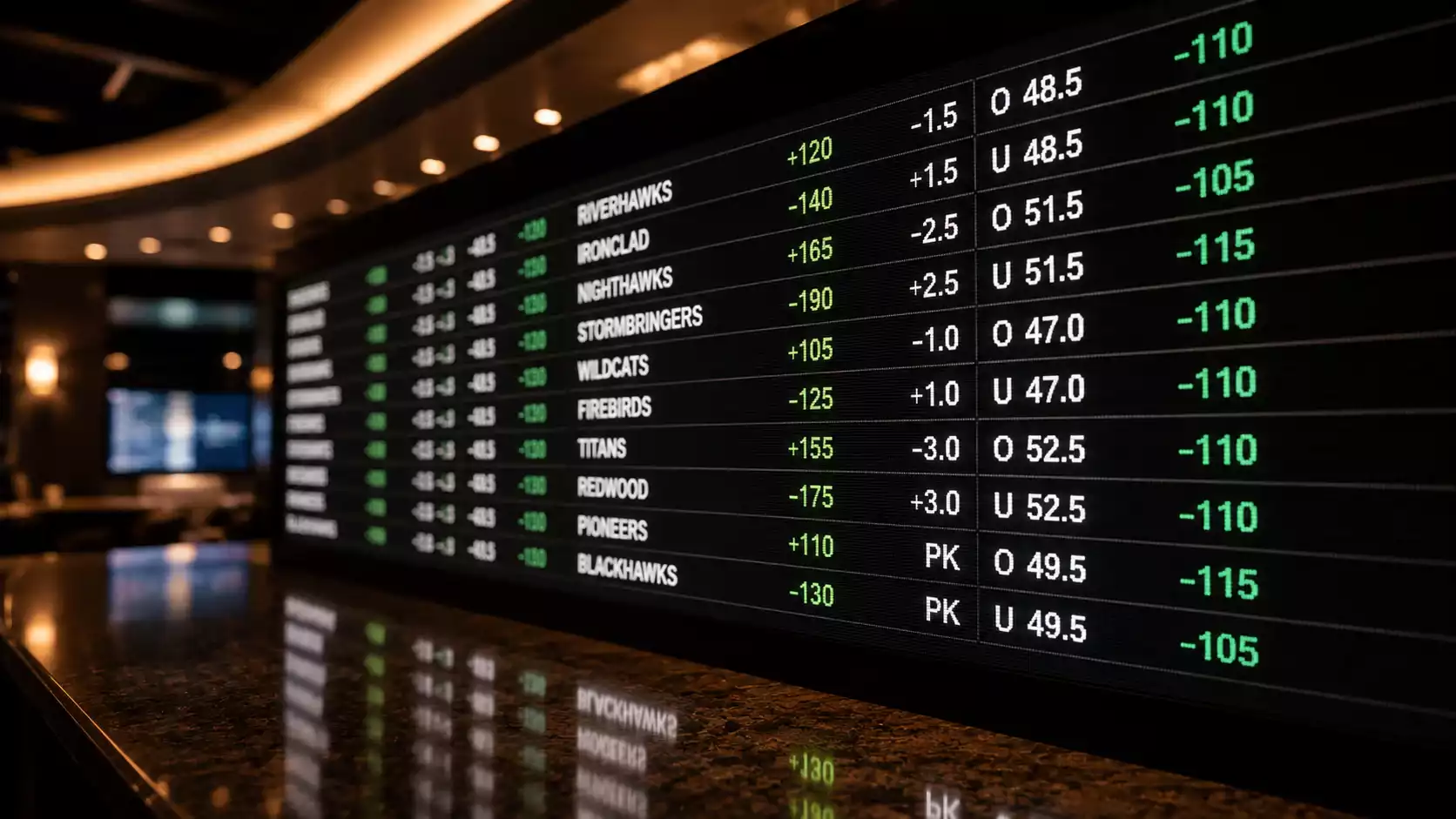
The three core categories are outright winners (Super Bowl, conference, division), over/under totals (season wins for a team), and player markets (MVP, Rookie of the Year, statistical leaders). Each operates with its own margin structure, its own liquidity patterns, and its own strategic considerations. Lumping them together is a common beginner error — the approach that works for a win-total over bet has almost nothing in common with a Super Bowl longshot play.
Odds Formats: Fractional, Decimal, and American
UK bookmakers default to fractional odds, which is the format I will use throughout this guide. But because much of the NFL data originates in the United States, you will constantly encounter American odds, and some UK platforms let you toggle to decimal. Being fluent in all three is basic literacy for this market.
Converting odds and calculating implied probability
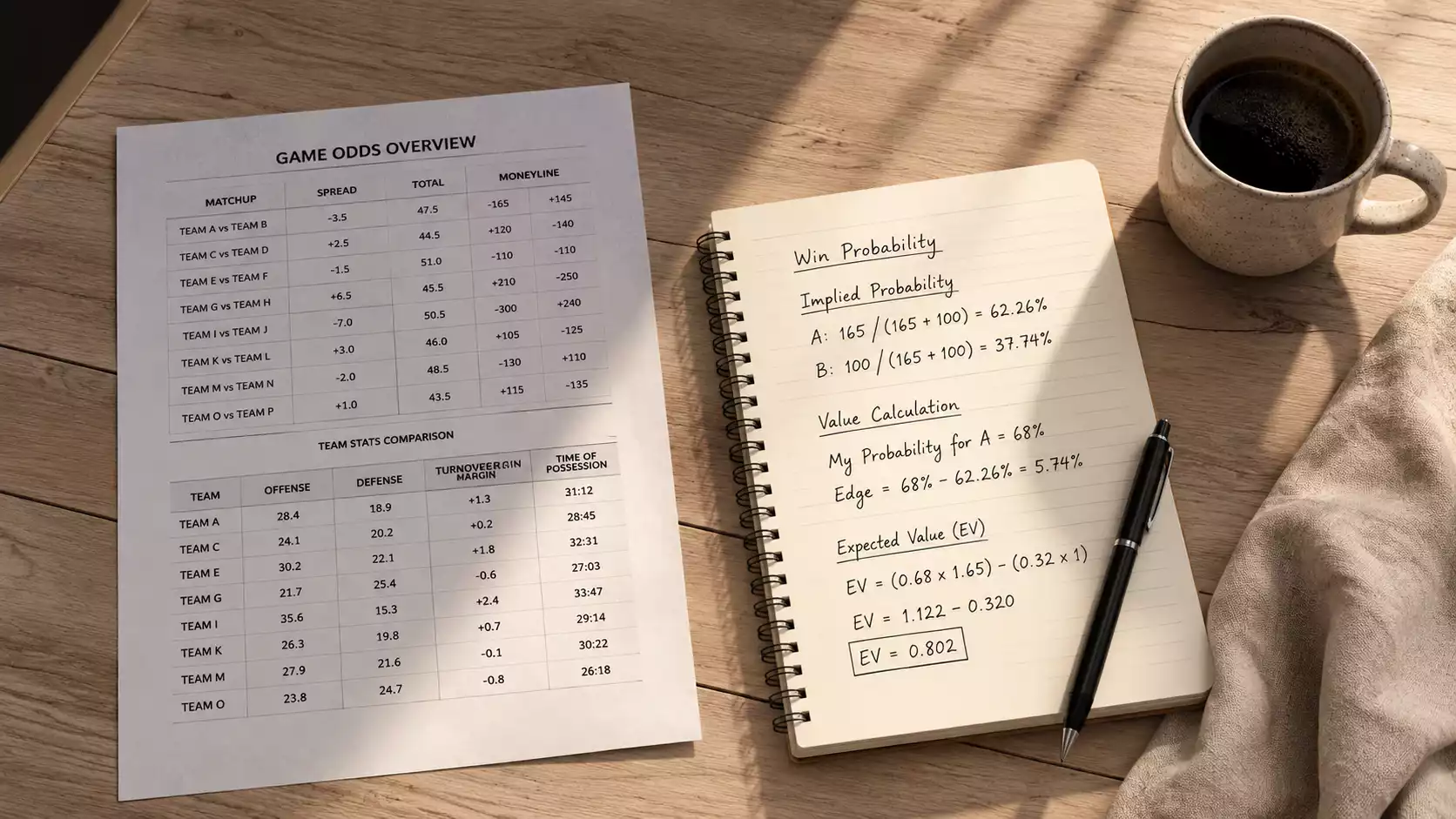
Suppose a team is listed at 7/1 fractional (8.00 decimal, +700 American). All three expressions describe the same price.
Fractional to implied probability: 1 / (7 + 1) = 0.125, or 12.5%.
Decimal to implied probability: 1 / 8.00 = 0.125, or 12.5%.
American (positive) to implied probability: 100 / (700 + 100) = 0.125, or 12.5%.
The implied probability tells you what the market believes. If your own assessment says that team wins 18% of the time, you have found a potential value gap. But remember — this 12.5% figure includes the bookmaker’s margin. The true probability the market assigns could be lower.
Ante-post — the traditional UK term for a futures bet, borrowed from horse racing. It means placing a wager before the event participants are finalised, accepting the risk that your selection might not compete.
Each-way — a bet structure where half your stake goes on the outright win and half on a “place” (typically top 2-4 finishers). Some UK bookmakers offer each-way terms on Super Bowl futures, which can provide downside protection on longshot selections.
Outright — a bet on which team or player will win a given market (Super Bowl, division, MVP). No point spreads, no conditions — just a straight win.
The Hold Problem: Why Futures Margins Dwarf Match-Day Vig
Here is the number that changes how you think about every futures bet you will ever place. The theoretical hold on NFL futures markets typically runs between 20% and 30%. On a Super Bowl outright market with 32 teams, that margin is baked across every price. Compare that with the roughly 4.5% hold on a standard point spread, and the scale of the disadvantage becomes visceral.
NFL Futures Hold & True Odds
Futures carry a brutal margin – 20–30% on the Super Bowl, over 54% on MVP, against 4.5% on a spread. A headline price means little until you strip that hold out. Enter a selection and see its true, no-vig odds and whether there’s real value.
How this works: a price converts to a raw implied probability – fractional a/b implies b ÷ (a+b), decimal implies 1 ÷ price. But in a futures market every runner’s price is padded, so the implied probabilities of the whole field sum to well over 100%: about 120–130% on the Super Bowl, up to 154% on MVP. Stripping that hold rescales your selection to its true, no-vig probability – here estimated as raw implied ÷ (1 + hold) using the typical margin for the market you picked. That true figure, not the headline price, is what your own read has to beat. Value exists only when your honest estimate sits above the true probability, and the break-even line is the raw implied of the price you’re actually paid – you still collect at the real odds, so that is the number your estimate must clear to profit. The lesson the maths enforces is the reason this site keeps repeating it: a 20/1 longshot is not “value” just because it’s a big number – on a 54%-hold MVP board, that price can hide a true probability barely half what it looks. Pick low-hold markets (win totals, divisions) where more of the price is real, and line-shop every selection, because futures prices swing 14/1 to 25/1 on the same runner. This is a pricing tool, not a prediction. Not financial advice. 18+ – GamStop and BeGambleAware are protection routes; National Gambling Helpline 0808 8020 133.
It gets worse on markets with more runners. The MVP market, with 88 or more listed candidates, can carry a hold exceeding 54%. As Covers.com host Joe Osborne has noted, reading too much into narratives is a trap — those factors are already embedded in the lines. That embedded margin means the narratives are priced in, but so is a massive house edge.
This does not make futures unbettable. It makes them a market where casual approaches virtually guarantee long-term losses. The strategic framework later in this guide exists because of that margin — every tool, every timing principle, every sizing decision is a response to the structural disadvantage built into the product.
Understanding the mechanics is the foundation. Now let us walk through each major market, starting with the one that attracts the most money and the most attention.
Super Bowl Futures: Reading the Championship Market
Super Bowl LX generated an estimated $1.76 billion in legal wagers in the United States alone. That figure does not include the UK market or the grey-market handle, which means the actual global volume on a single game dwarfs the annual GDP of some small nations. When you place a Super Bowl futures bet, you are wading into the deepest, most liquid, and most efficiently priced market in all of sports betting.
Efficient does not mean fair, though. It means the favourites are priced tightly and the edges tend to live at the margins — in the 20/1 to 50/1 range where casual money does not flow and bookmakers have less incentive to sharpen their lines.
| Tier | Typical Fractional Odds Range | Implied Probability Range | Characteristics |
|---|---|---|---|
| Elite Favourites | 3/1 to 6/1 | 14-25% | Established QB, deep roster, playoff pedigree |
| Contenders | 8/1 to 14/1 | 7-11% | Playoff-calibre with a clear path but notable question marks |
| Dark Horses | 16/1 to 33/1 | 3-6% | Young QB trajectory or major roster upgrade; value lives here |
| Longshots | 40/1 and above | Below 2.5% | Speculative plays requiring multiple things to break right |

Since 2009, 11 of the last 16 Super Bowl winners were underdogs on the pre-game betting line — including every one of the last three champions. The championship is not a favourites’ playground; it is a tournament where variance reigns and a hot defensive stretch or a quarterback playing above his ceiling can override regular-season form.
The Philadelphia Eagles opened at 50/1 before the 2017 season and won it all. Both finalists in Super Bowl LX — Seattle and New England — started the year at long prices that most casual bettors would have dismissed. These are not anomalies. They are the pattern. NFL parity, the salary cap, and the single-elimination playoff format create an environment where pre-season market pricing systematically undervalues teams one roster move or one breakout performance away from contention.
For the 2026 season, the work begins with identifying which teams in the dark-horse tier have the roster trajectory, the schedule profile, and the quarterback ceiling to outperform their current market price. I break down the full methodology, specific picks, and bookmaker-by-bookmaker pricing in the dedicated Super Bowl futures odds analysis. Here, I want to anchor one principle: the Super Bowl market rewards bettors who treat it as a value hunt, not a prediction exercise. You do not need to pick the winner. You need to find prices that understate a team’s true probability of getting there.
NFL MVP Futures: The Quarterback Premium
I stopped betting non-quarterbacks for MVP in 2018. Not because I had some philosophical objection, but because the data made the case so clearly that persisting felt like stubbornness rather than analysis. The last non-quarterback to win the award was Adrian Peterson in 2012, and that was a freakish 2,097-yard rushing season that voters could not ignore. Since then, MVP has been an exclusive club for signal-callers, and everything about the voting pattern suggests that will not change.
The MVP market with 88 or more listed candidates can carry a theoretical hold exceeding 54%. That means if you added up the implied probabilities of every player on the board, the total would come to roughly 154% — the extra 54% is the bookmaker’s built-in margin. Compare that with the 20-30% hold on Super Bowl futures, and you see why MVP is one of the least bettor-friendly markets in all of sports.
That hold figure alone should reshape your approach. When more than half the implied probability on the board is house margin, the bar for finding genuine value becomes extraordinarily high. You are not just looking for the right player — you are looking for a player whose true probability of winning meaningfully exceeds a price that is already inflated by the vig.
The 54% hold on the MVP market means more than half the implied probability on the board is pure bookmaker margin. Every MVP futures bet starts from a deeper deficit than almost any other wager you can place.
The profitable framework narrows to a handful of principles. First, only quarterbacks deserve serious consideration — the voting history since 2012 is unambiguous. Second, team record matters as much as individual statistics; voters consistently favour QBs on teams with 12 or more wins. Third, the narrative arc matters — a player who starts hot and sustains it through November builds the kind of momentum that voters reward, whereas a late-season surge often comes too late to shift the conversation.
I cover candidate tiers, specific value plays, and the data behind each selection in the full NFL MVP odds and futures breakdown. For the pillar-level takeaway, treat the MVP market with extreme selectivity. If you cannot articulate a clear case for why a quarterback’s true win probability exceeds his market-implied probability by at least 5-8 percentage points after accounting for the hold, the bet is not worth placing.
Season Win Totals: Betting Overs and Unders
If someone asked me which NFL futures market gives the sharpest bettors their best chance at a long-term edge, I would say win totals without hesitation. Not because they are easy — nothing in sports betting is — but because they are the most data-friendly market on the board. A Super Bowl outright bet asks you to predict one winner from 32 teams across a six-month marathon. A win-total bet asks a simpler question: will this team win more or fewer games than the number the bookmaker has posted?
Over Advantages
Teams with strong underlying metrics (high EPA, positive point differential) that underperformed their expected win total often bounce back. A team that went 8-9 but had the statistical profile of a 10-win squad is a classic over candidate. Overs also benefit from positive roster changes — a major free-agent signing or a high draft pick at a premium position can shift a team’s trajectory in ways the market underprices before the season.
Under Advantages
Teams that benefited from unsustainable luck — a league-leading record in close games, a historically low turnover rate, or an easy schedule that inflated their record — are prime under candidates. Regression is not a theory in the NFL; it is a mathematical inevitability that shows up year after year when you track close-game records and turnover differential.
NFL generates more betting handle than any other sport in the United States — a single Sunday slate produces more turnover than entire weeks of baseball or basketball combined. That liquidity means win-total lines are sharp, but it also means the market reacts strongly to headline events like coaching changes and quarterback injuries, sometimes overcorrecting in ways that create windows of value.
| Win Total Line | Over Odds (example) | Under Odds (example) | Push Rule |
|---|---|---|---|
| 9.5 wins | 10/11 | 10/11 | No push possible (half-point line) |
| 9 wins | 10/11 | 10/11 | Exactly 9 wins = push, stakes returned |
| 8.5 wins | 5/6 | evens | No push possible |
The push mechanic on whole-number lines is an underappreciated factor. If you bet the over on 9 wins and the team finishes exactly 9-8, your stake returns. Some bookmakers offer half-point lines to eliminate pushes, but those come at a price — the odds shift to compensate. Understanding which format your bookmaker uses, and whether the extra half-point is worth the juice, is a small detail that compounds across a portfolio of ten or fifteen win-total positions.
Regression signals, schedule strength adjustments, and specific over/under picks for the current season are covered in depth in the NFL win totals betting guide. The core principle here: win totals are where process-driven bettors earn their edge, because the inputs — point differential, Pythagorean expectation, roster continuity, schedule difficulty — are measurable, trackable, and testable against historical baselines.
Division and Conference Winner Markets
There is a reason I allocate a meaningful chunk of my futures portfolio to division winners every year, and it has nothing to do with thinking I can predict which team will top the NFC West. It has everything to do with maths. A division winner market has four runners. A Super Bowl outright market has 32. Fewer runners means less margin baked into the board — the hold on a four-team division market is structurally lower than the hold on a championship outright, which means more of the implied probability reflects genuine assessment rather than bookmaker padding.
That margin advantage is the starting point, but the strategic value goes deeper. Division futures let you isolate your thesis. If you believe a specific team is undervalued but you are not confident enough to back them at 25/1 for the whole championship, you can back them to win a four-team race where the path is shorter and more predictable. A team does not need to survive three playoff rounds to win its division — it needs to outperform three direct rivals over seventeen games, and the data inputs for that question (head-to-head history, roster quality, schedule overlap) are far more tractable.
Weak Division Play
When a division has no clear dominant team, the market spreads implied probability evenly. A team priced as the third favourite at 4/1 in a wide-open division can represent serious value if your model gives them a 30% chance.
Dominant Favourite Play
When one team is heavily favoured (1/2 or shorter), the value often sits with the field. Some bookmakers offer “any other team” pricing that aggregates the outsiders into a single position.
Conference Winner as Middle Ground
Conference winner markets sit between division and Super Bowl in both runner count and margin. Use conference winners when your conviction extends beyond divisional dominance to playoff depth.
The relationship between division, conference, and Super Bowl odds also creates hedging and stacking opportunities. If you hold a 20/1 Super Bowl ticket on a team that reaches the conference championship, the live odds on the opposing conference finalist become a natural hedge position. Division and conference markets are not standalone bets — they are portfolio tools that let you build layered exposure to your highest-conviction plays while managing the variance that makes futures inherently volatile.
Season-Long Player Props: Yards, Touchdowns, and Awards
Season-long player props are where the casual bettor’s enthusiasm collides hardest with the bookmaker’s margin advantage. The appeal is obvious — backing your favourite quarterback to lead the league in passing yards feels personal, connected to something you will watch unfold week by week. But the emotional appeal is precisely what makes these markets so profitable for the house.
The Rookie of the Year market — split into Offensive (OROY) and Defensive (DROY) awards — is one of the most compelling player-futures markets for value seekers. Unlike MVP, where the winner is almost certainly a quarterback, rookie awards are won by a wider range of positions. Running backs, wide receivers, cornerbacks, and edge rushers all have realistic paths to these awards, which means the market has more structural inefficiency to exploit.
Passing yards leader, rushing yards leader, and touchdown leader markets all hinge on volume as much as talent. The quarterback who throws the most passes is not always the best — he is often the signal-caller on a team that trails frequently and operates at a high pace. The rushing yards leader needs a dominant carry share and an offensive line that creates running lanes, factors that correlate less with individual talent than with team context.
The parlay trap is the biggest hazard in player-prop territory. The share of parlays now exceeds 30% of total betting handle, up from less than 15% in 2019. Same-game parlays carry a hold of 20-35%, making them the single most profitable product for bookmakers. When you bundle a player’s yards over with his team’s win and another player’s touchdown prop, you are compounding the house edge across every leg.
My approach to season-long player props is selective and data-anchored. I look for volume mismatches — a quarterback moving to a system that projects for significantly more pass attempts, or a running back inheriting a clear lead role on a team with a strong offensive line. The statistical indicators (pass attempts per game, target share, red-zone carries) are publicly available and far more predictive than name recognition or fantasy football hype. Awards markets, particularly OROY and DROY, offer the most exploitable inefficiencies because draft-day sentiment creates sharp price moves that do not always reflect a player’s actual probability of winning the award once snap counts stabilise in October.
Futures Betting Strategy: A Data-Driven Framework
Only 3-5% of sports bettors turn a profit over the long term. That number is not a scare tactic — it is the baseline reality that every strategic decision in this section is designed to address. If the default outcome is losing, then the strategy cannot be “pick winners.” The strategy has to be “build a process that shifts the odds of being in that 3-5% bracket.”
The most profitable NFL futures bettors treat long-term wagers as a portfolio rather than individual bets, spreading exposure across multiple positions to hedge against variance while maintaining upside on high-conviction plays. That portfolio metaphor is not decorative language. It is the operational principle that separates structured futures betting from glorified lottery tickets.
Five Steps Before Placing Any Futures Bet
- Calculate the implied probability from the offered odds and compare it against your own model or assessment. If you cannot articulate why you believe the true probability is higher than the market implies, stop here.
- Check the hold on the specific market. A 25% hold means you need a 25% edge just to break even before accounting for the vig on your specific selection.
- Verify the price at a minimum of three bookmakers. Odds dispersion on futures is far wider than on match-day markets, and a few percentage points of extra value compounds significantly over a season-long portfolio.
- Size the bet as a percentage of your total futures bankroll, not your overall bankroll. Futures lock up capital for months — treat that opportunity cost as part of the calculation.
- Record the bet with your rationale, the odds, the date, and the data points supporting the position. If you cannot write a coherent paragraph explaining the bet, you do not have a thesis — you have a hunch.

Timing Windows
Futures prices are not static. They shift at predictable inflection points — post-Super Bowl, during free agency, after the draft, and mid-season when results create buying opportunities. Each window has a different character. Post-Super Bowl prices reflect recency bias. Free agency creates sudden moves when a quarterback changes teams. The draft reshuffles the deck, particularly for teams adding a first-round quarterback.
The mid-season window is the one most bettors ignore, and it is often the richest. A team that starts 2-4 but has strong underlying metrics can see its Super Bowl odds drift to 40/1 or longer. If your pre-season analysis identified that team as a contender, the mid-season price is a gift. I cover the full timing calendar in the NFL futures betting strategy deep-dive.
Do
- Spread futures exposure across multiple markets (Super Bowl, division, win totals, select player props) to diversify variance
- Use EPA per play, DVOA, and Pythagorean expectation as starting points — these metrics have stronger predictive power than win-loss record
- Revisit positions at each timing window and add to winning theses when the price still offers value
- Keep a written record of every futures bet with your reasoning and the market hold
Don’t
- Bet more than 1-3% of your futures bankroll on any single position — the variance is enormous and the lock-up period prevents cutting losses
- Stack correlated positions without understanding the correlation — backing a team for Super Bowl, their QB for MVP, and their RB for rushing title creates concentrated exposure
- Chase narrative momentum without checking the data — a three-game winning streak is a media story, not an investment thesis
- Ignore the hold when evaluating value — a 16/1 shot is not “value” if the hold-adjusted implied probability exceeds your estimate
Contrarian Value and Regression
The public money in NFL futures flows predictably toward teams with recent success, star-power quarterbacks, and media attention. That flow creates systematic overpricing of popular teams and underpricing of less glamorous squads with strong fundamentals.
Regression to the mean is your most reliable analytical tool. Teams that won a disproportionate share of close games in the prior season almost always regress the following year. Teams with extreme turnover differentials tend to move toward average. These are not opinions; they are statistical patterns that have held across decades of NFL data. When you identify a team whose win total appears inflated by close-game luck and an unsustainably positive turnover margin, the under on their win total becomes one of the most data-supported positions in the entire futures market.
Over 76 million Americans bet on NFL games last season, but engagement and profitability are different things entirely. The contrarian bettor’s edge comes from recognising that the vast majority of that activity is recreational and sentiment-driven, creating pricing inefficiencies that a disciplined approach can exploit.
The portfolio approach to futures is not about predicting outcomes. It is about systematically identifying prices that understate probabilities, sizing positions to survive the inevitable misses, and letting the law of large numbers work across a diversified set of holdings.
Line Shopping: Comparing NFL Futures Odds Across Bookmakers
Last season I tracked the same Super Bowl futures bet across four UK bookmakers for three months. The widest disparity I recorded was staggering — one platform had a team at 14/1 while another listed the same team at 25/1. On a match-day spread, you might see a half-point difference. On futures, the gaps are canyons.
The reason futures prices diverge so dramatically is structural. Unlike point spreads, where sharp money quickly compresses lines across the market, futures markets are less liquid and more influenced by each bookmaker’s individual liability profile. A platform that has taken heavy action on one team will shorten those odds to manage exposure, while a competitor with less liability on that team has no reason to move. The result is a landscape where the same position can offer radically different expected value depending on where you place it.
| Selection | Bookmaker A | Bookmaker B | Bookmaker C | EV Difference (A vs C) |
|---|---|---|---|---|
| Team X — Super Bowl | 16/1 | 20/1 | 25/1 | +53% higher payout at C for identical risk |
| Player Y — MVP | 8/1 | 10/1 | 12/1 | +44% higher payout at C |
| Team Z — Division | 5/2 | 3/1 | 7/2 | +40% higher payout at C |
Illustrative example. Odds are hypothetical and shown for educational purposes only.
Flutter Entertainment — the parent company behind several major UK betting brands — reported group revenue of $15.91 billion for 2025, a 17% increase on the prior year. That revenue comes from somewhere, and a meaningful slice comes from bettors who accept the first price they see rather than taking sixty seconds to check the competition. Line shopping is the simplest edge-generating activity available to a futures bettor, and it requires zero analytical skill — just the discipline to compare before committing.
How price differences affect expected value
Suppose your model gives Team X a 6% chance of winning the Super Bowl. At 16/1 (implied probability 5.9%), the bet is essentially break-even. At 25/1 (implied probability 3.8%), the same 6% estimate creates a meaningful positive-EV position. The team has not changed. Your analysis has not changed. The only variable is where you placed the bet.
Over a portfolio of 15-20 futures positions, consistently taking the best available price can shift your aggregate expected value by several percentage points — enough to move from a losing proposition to a marginally profitable one before accounting for any analytical edge.
For UK-based bettors, the practical guide to which bookmakers offer the deepest NFL futures coverage, how to navigate fractional-vs-decimal display settings, and which platforms tend to offer the most competitive outright prices is covered in the NFL futures odds comparison guide. The operational rule is simple: never place a futures bet at a single bookmaker without checking at least two alternatives. The sixty seconds it takes will improve your long-term results more than any amount of team analysis.
NFL Futures Betting in the UK: What British Punters Need to Know
When I started covering NFL markets nearly a decade ago, finding a British bookmaker that listed anything beyond the Super Bowl outright was a genuine challenge. Today, the landscape is unrecognisable. The UK now has approximately 14.3 million NFL fans — nearly one in five adults — and 68% of them are in the 18-44 age bracket that bookmakers prize most. That demographic shift has dragged NFL futures coverage from a niche afterthought to a featured offering across every major UK betting platform.
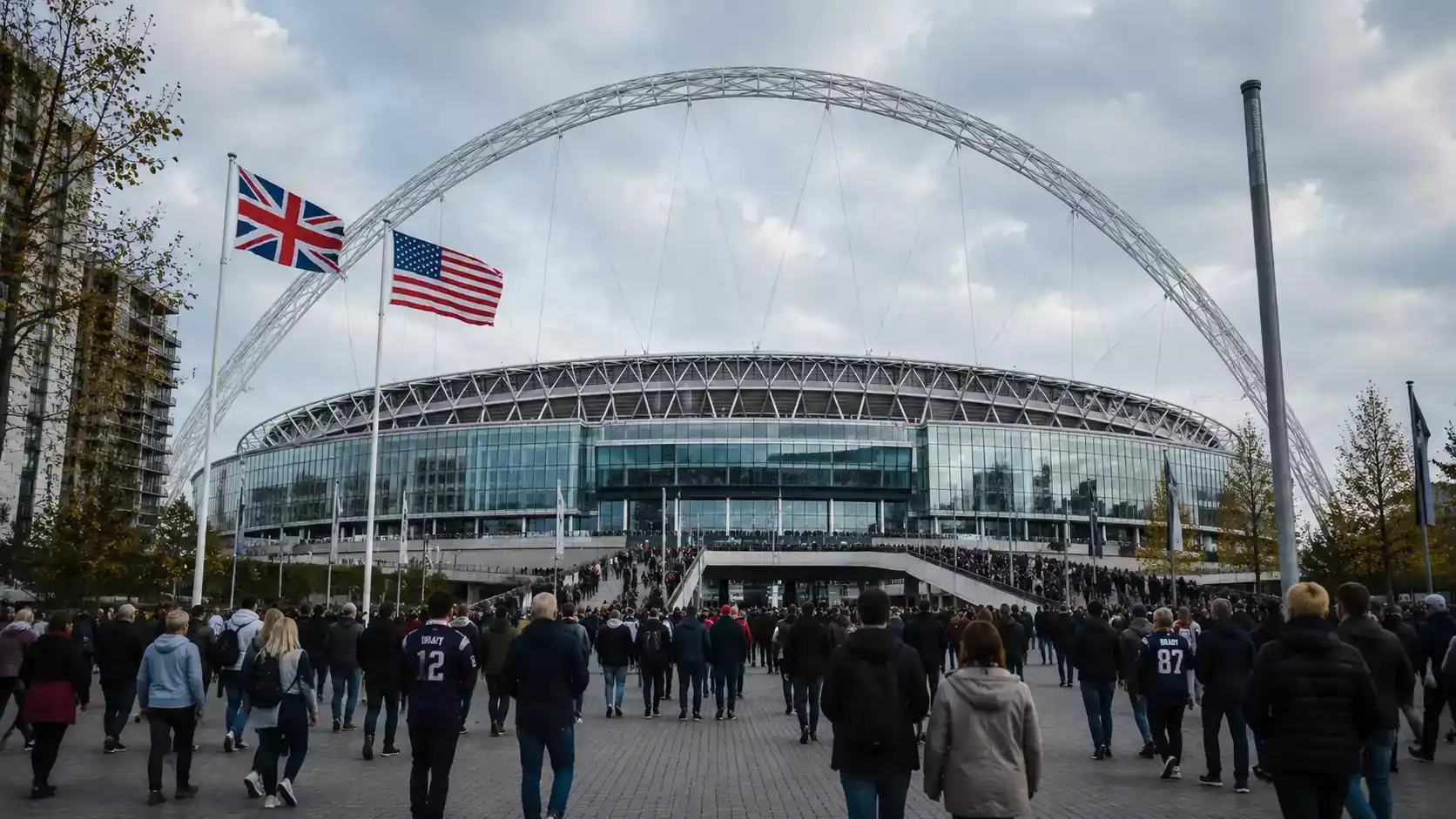
The record attendance for an NFL game outside the United States stands at 86,651 — set at Wembley Stadium in October 2024. The 2025 season featured a record seven overseas regular-season games, three of them in London. The NFL’s investment in the UK market is not a marketing experiment; it is a long-term strategic commitment that has fundamentally reshaped British sports culture.
That growth story has a direct impact on betting markets. As Smart Betting Guide’s research team noted, cities like Croydon, Newcastle, and Manchester are showing disproportionate search activity levels for American football, signalling a growing and digitally engaged fan culture that extends well beyond London. More fans means more betting activity, more betting activity means deeper markets, and deeper markets mean sharper odds and more competitive pricing — a virtuous cycle for the informed bettor.
The UK Gambling Commission (UKGC) regulates all sports betting activity in Britain under the Gambling Act 2005. Every bookmaker offering NFL futures to UK customers must hold a UKGC licence, which mandates consumer protections including deposit limits, self-exclusion tools, and reality checks. The UK market generated gross gambling yield of approximately 16.8 billion pounds in 2025, with the online sector — where most NFL futures betting occurs — growing at 8% year-on-year.
Three practical points matter for UK-based NFL futures bettors. First, your default odds format is fractional, but most platforms let you toggle to decimal. For comparison purposes, decimal is often clearer because mental arithmetic is simpler when scanning prices across bookmakers. I recommend fractional for placing bets and decimal for comparison shopping.
Second, UK betting winnings are tax-free. The gambling duty is paid by the operator, not the punter — a structural advantage over American bettors who face state and federal tax obligations on winnings. On a 50/1 longshot that pays out, the difference is substantial.
Third, the London NFL games create a unique informational asymmetry. British fans who attend these games and track travel-related performance data have access to a perspective the US-centric market does not fully price in. Whether a team’s London trip disrupts their momentum or fuels a second-half surge is soft data that can inform futures positioning in ways pure statistical models miss.
UK punters make roughly 290 million online bets on real events every month, and about 10% of the population actively bets on sport. You are operating in one of the world’s most sophisticated betting environments — the tools, the regulation, and the competitive pricing all work in your favour compared with most other jurisdictions. The challenge is not access. It is discipline.
Setting Limits: Responsible Futures Betting
I have spent the last nine years in this industry, and the most important number I have encountered is not an odds line or a margin percentage. It is this: only 3-5% of sports bettors are profitable over the long term. That means the overwhelming majority — 95-97% — are net losers. If you take nothing else from this guide, take that number and sit with it before you place a single wager.
52% of online bettors have chased losses, and 37% have experienced shame after losing. These are not outlier behaviours — they are the statistical norm. Acknowledging them honestly is the first step toward a healthier relationship with futures betting.

Futures betting carries a specific psychological risk that match-day betting does not. A Sunday spread bet settles within hours. A Super Bowl futures bet placed in July lives with you for six months. That extended timeline creates emotional attachment that can distort decision-making — doubling down on early-season promise, hedging nervously near the playoffs, or obsessing over a position that represents 2% of your bankroll.
The AGA’s Bill Miller has said that the regulated industry is built on strong consumer protections and a shared commitment to responsibility, ensuring that the gameday experience remains enjoyable regardless of the outcome. That aspiration matters, but it only works if bettors use the tools available to them.
The UK Gambling Commission requires all licensed bookmakers to offer deposit limits, loss limits, session time reminders, cooling-off periods, and self-exclusion through the GAMSTOP national scheme. If you are placing NFL futures bets through any UK-regulated platform, these tools are available to you right now in your account settings. Use them proactively — set a deposit limit before you start, not after you have exceeded a boundary you never formally defined. GambleAware (gambleaware.org) offers free, confidential advice and support for anyone concerned about their gambling.
My personal rule for futures bankroll allocation is straightforward. I set a fixed amount at the start of each NFL cycle — an amount I can lose entirely without it affecting my life, my mood, or my relationships. That amount becomes my futures bankroll for the season. Individual positions never exceed 3% of that bankroll, and my total futures exposure across all markets is capped at 40% of the bankroll at any time, with the remainder held as reserve for mid-season opportunities. If the bankroll reaches zero, the season is over. No reloading, no chasing, no exceptions.
NFL Futures Betting: Frequently Asked Questions
What are NFL futures bets and how do they work?
NFL futures bets are wagers on outcomes decided weeks or months after you place the bet — Super Bowl winner, conference and division champions, MVP, and season win totals being the most common. Your stake is locked until the market settles. If you back a team at 20/1 in July and they win the Super Bowl in February, you collect at those original odds regardless of how the price moved during the season. The trade-off is the time value of your money — capital is locked for the duration.
When is the best time to place NFL futures bets?
Four primary windows offer distinct advantages. The post-Super Bowl window captures overreaction to the championship result. The free-agency window creates sharp price moves when marquee players change teams. The post-draft window reprices teams based on rookie additions, particularly first-round quarterbacks. The mid-season window provides value on teams whose records do not reflect their underlying performance. The most effective approach uses all four rather than placing your entire portfolio in a single burst.
What types of NFL futures bets can you place?
The major categories are championship outrights (Super Bowl, AFC/NFC conference, division winners), season win totals (over/under on regular-season wins), individual awards (MVP, Rookie of the Year, Defensive Player of the Year), and season-long statistical props (passing, rushing, and touchdown leaders). UK bookmakers vary in depth — most offer Super Bowl, division, and MVP futures, while statistical leader markets may only be available on platforms with extensive American football coverage.
How much vig do sportsbooks charge on NFL futures?
The theoretical hold on NFL futures markets is dramatically higher than on match-day bets. Super Bowl outright markets typically carry a 20-30% hold, meaning if you added up the implied probabilities of all 32 teams, the total would sum to 120-130% rather than 100%. On MVP futures with 88 or more candidates, the hold can exceed 54%. Compare this with the roughly 4.5% hold on a standard point spread. This margin difference is the single most important factor that makes futures harder to beat than match-day betting, and it is the reason that line shopping, timing, and selectivity are not optional refinements but essential requirements.
Can you hedge or cash out an NFL futures bet?
Yes, and this is one of the genuine advantages of futures positioning. If your team reaches the playoffs, their live odds will have shortened considerably. You can use your bookmaker’s cash-out feature (which typically offers less favourable terms) or manually hedge by betting against your team in a specific playoff game. Manual hedging usually provides better value because you control the timing and the odds, but it requires accounts at multiple bookmakers and calculating the hedge amount to lock in your desired profit or loss-reduction target.
What is the best strategy for NFL futures betting?
A portfolio strategy — diversifying across multiple markets rather than concentrating on a single play. Size each position at 1-3% of your dedicated futures bankroll. Use data-driven metrics (EPA per play, DVOA, Pythagorean expectation) rather than narratives for team evaluation. Line shop across at least three bookmakers for the best price. Time your entries to exploit the windows where odds offer maximum value. Maintain a contrarian stance toward teams whose prices are inflated by public money. The framework shifts the odds of long-term profitability in your favour without guaranteeing individual winners.
Are NFL futures bets worth it for casual bettors?
That depends on what “worth it” means. If measured by expected return, the high hold percentages make futures difficult for anyone not applying rigorous analysis — the 20-30% margin on championship markets is a significant structural disadvantage. If worth includes entertainment value — months of engagement with the season, a personal stake in outcomes, an enhanced viewing experience — then a small, controlled futures portfolio can enrich your NFL season considerably. The key is honesty about which category you fall into. Betting for entertainment? Set a strict budget and treat any payout as a bonus. Betting to profit? The strategy framework in this guide is your minimum viable toolkit.
Created by the ”Best nfl Futures Bets” editorial team.