NFL Regression Candidates 2026: Teams to Fade
 Available in US
In the 2023 season, I identified a team that had gone 11-6 the year before as a prime regression candidate. Their underlying numbers were ugly: they’d won five games by a single score, their turnover differential was +12 despite mediocre defensive play, and their quarterback had the highest fourth-quarter passer rating in the league — a stat that tends to regress violently. I bet the under on their win total and backed a division rival that looked underpriced because the market was anchored to that inflated 11-win record. The regression hit exactly as projected. The team fell to 8-9. The rival I’d backed won the division. Two profitable positions from a single regression thesis.
Regression to the mean is the most powerful and most underused analytical tool in NFL futures betting. It doesn’t predict that good teams will become bad or bad teams will become good. It predicts that teams whose records were inflated by unsustainable performance factors — close-game luck, extreme turnover differentials, unusually low injury rates — will see those factors normalise, pulling their results back toward what their underlying talent level suggests. The market consistently overweights last year’s record and underweights the sustainability of the performance behind it.
Statistical Indicators for Team Regression
After years of testing various metrics, I’ve settled on five indicators that most reliably predict which teams are headed for a correction. Each one is quantifiable before the season starts, which makes them actionable for preseason futures positions.
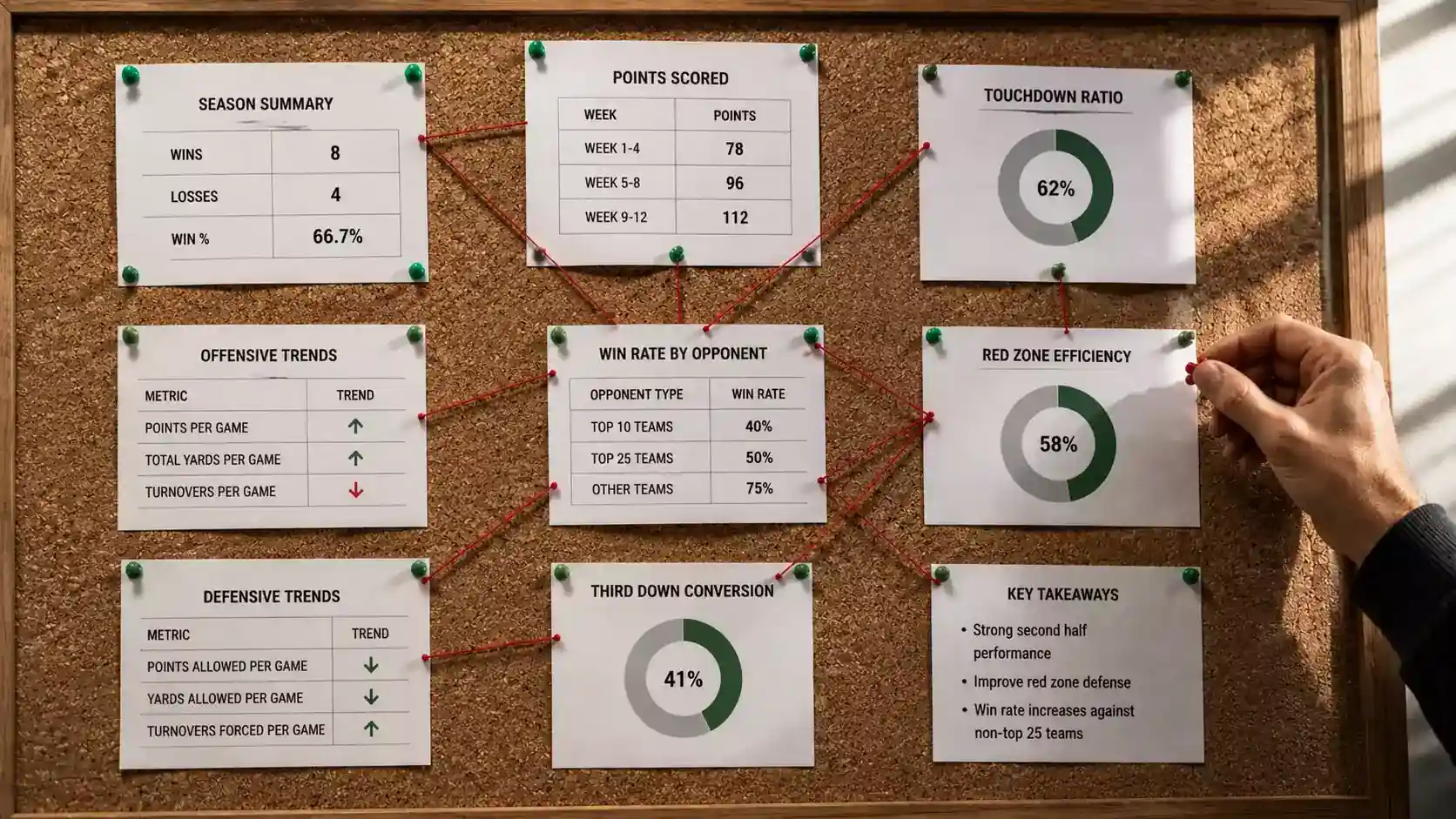
The first is close-game record. Teams that win a disproportionate share of games decided by seven points or fewer — say 7-2 or better — are borrowing from future wins. The historical data is unambiguous: close-game win rates revert sharply toward 50% in the following season. A team that went 8-1 in one-score games is far more likely to go 4-5 in those situations the next year than to repeat the dominance. I calculate each team’s expected wins using their point differential (the Pythagorean expectation method) and compare it to their actual record. The gap between the two is the “luck factor,” and it’s the single strongest predictor of regression.
The second indicator is turnover differential. A team that finishes +10 or higher in turnovers is almost certainly benefiting from unsustainable fumble recovery rates and interception luck. Fumble recoveries are essentially random — approximately 50/50 regardless of team skill — and a team that recovered 60% or more of all fumbles in a season will see that number collapse back toward the mean. I weight fumble-recovery luck more heavily than interception differential because interceptions have a larger skill component, though both regress.
The third is injury luck. Teams that avoided significant injuries to key starters — particularly at quarterback, offensive tackle, and edge rusher — are likely to face more normal injury attrition the following year. I track games missed by starters weighted by positional value and flag teams in the bottom quartile of injury impact as candidates for negative regression.
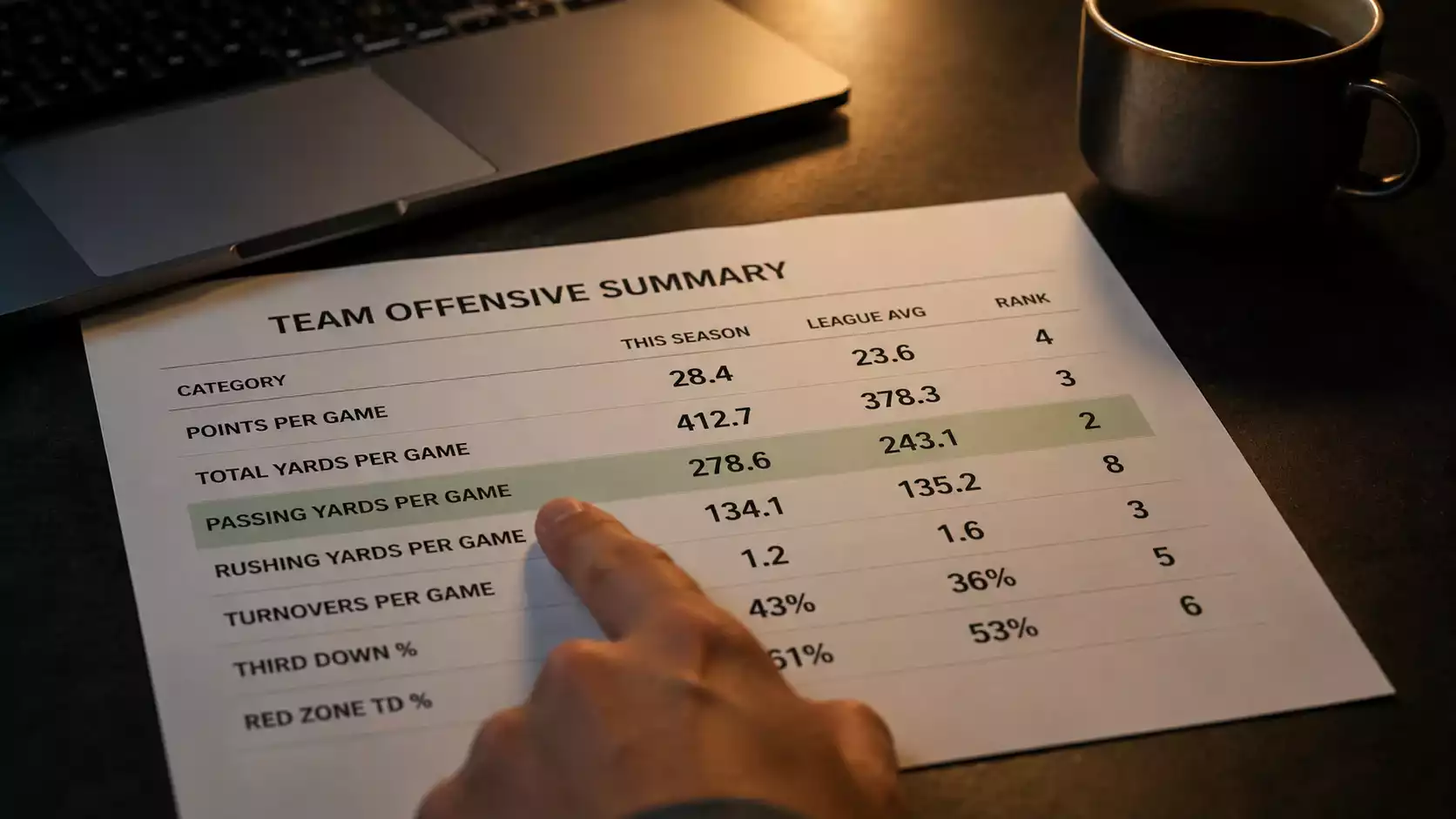
The fourth is schedule-adjusted efficiency. Using EPA (expected points added) per play on both offence and defence, I identify teams whose win totals significantly exceeded what their per-play efficiency would predict. A team can outperform its efficiency for a season through special teams play, red-zone performance, or situational football, but those factors are less stable year to year than per-play efficiency.
The fifth is roster turnover. Teams that lost significant contributors to free agency, retirement, or trade without adequate replacements face a structural downgrade that the market sometimes ignores when it anchors to last year’s record. I quantify this by summing the approximate production value lost and comparing it to the production value added.
2026 Regression Candidates: Teams to Fade
Rather than naming specific teams — whose circumstances will have evolved by the time you read this — I’ll describe the composite profile of a fade candidate and explain how to identify them on the current board.
The ideal fade target is a team priced with a win total of 10+ that won 11-13 games last year but whose Pythagorean expectation was 2+ wins lower than their actual record. They won at least six one-score games, their turnover differential was +8 or higher, and they lost at least two meaningful starters in the offseason. Their schedule has toughened — either through division rivals improving or through the rotating-opponent formula placing them against a stronger set of non-divisional foes.
BetMGM’s trading desk provides a useful lens here. When their trading manager Christian Cipollini identifies teams as “worst outcomes” for the book, he’s flagging teams that have attracted heavy public money at short prices — precisely the overvalued teams that regression analysis tells us to fade. Monitoring which teams the books fear most because of public liability concentrations gives you an indirect confirmation of where the market is most likely to have overpriced recent performance.
The underdog trend at the championship level reinforces the regression thesis from a different angle. Since 2009, 11 of 16 Super Bowl winners entered the game as underdogs, including each of the three most recent champions. Teams at the top of the standings are often the ones most vulnerable to regression, while teams slightly below the top tier — the ones priced at 8-1 or 12-1 rather than 3-1 — are more likely to have sustainable underlying profiles.
From Fade to Sleeper: How Regression Creates Value Elsewhere
Regression is not just about identifying teams to bet against. It’s a reallocation mechanism that redirects value across the entire market. When a team regresses from 12 wins to 9, the wins it “lost” have to go somewhere — they’re absorbed by opponents who beat them, particularly division rivals. This is why regression analysis naturally pairs with sleeper identification.
If I identify a division with one clear regression candidate, I immediately look at the other three teams in that division for potential sleeper value. A team that went 8-9 last year in a division where the top team won 12 games might project to 10-7 if the regression candidate drops three wins and two of those losses come in head-to-head divisional matchups. The market may still have the sleeper priced at 9.5 wins because it’s anchored to last year’s 8-win record, while the true projection is a win or more higher.
The portfolio approach works particularly well here: a win-total under on the regression candidate paired with a win-total over on the sleeper creates a partially hedged position where the same underlying thesis — regression at the top of the division — drives both bets in the right direction. This is precisely the kind of correlated-but-not-identical pairing that builds robust futures portfolios. The sleepers and longshot guide covers how to evaluate these emerging value targets in detail.
What is regression to the mean in NFL betting?
Regression to the mean is the statistical tendency for extreme performances to move back toward the average over time. In NFL betting, it means that teams with unusually high close-game win rates, turnover differentials, or injury luck are likely to see those factors normalise in subsequent seasons, pulling their win total closer to what their underlying talent level predicts. It does not mean every good team will decline — only those whose records were inflated by unsustainable factors.
How reliable is turnover differential as a regression predictor?
Turnover differential is one of the most reliable regression indicators because it contains a large random component, particularly fumble recoveries. Teams with extreme positive differentials (+10 or higher) regress sharply in the following season. Interceptions have a slightly larger skill component than fumble recoveries, so I weight fumble-related luck more heavily in my regression models, but both metrics are strong predictors of directional change.
Prepared by the Best nfl Futures Bets editorial staff.