NFL Futures Liability: Sportsbook Risk Management
 Available in US
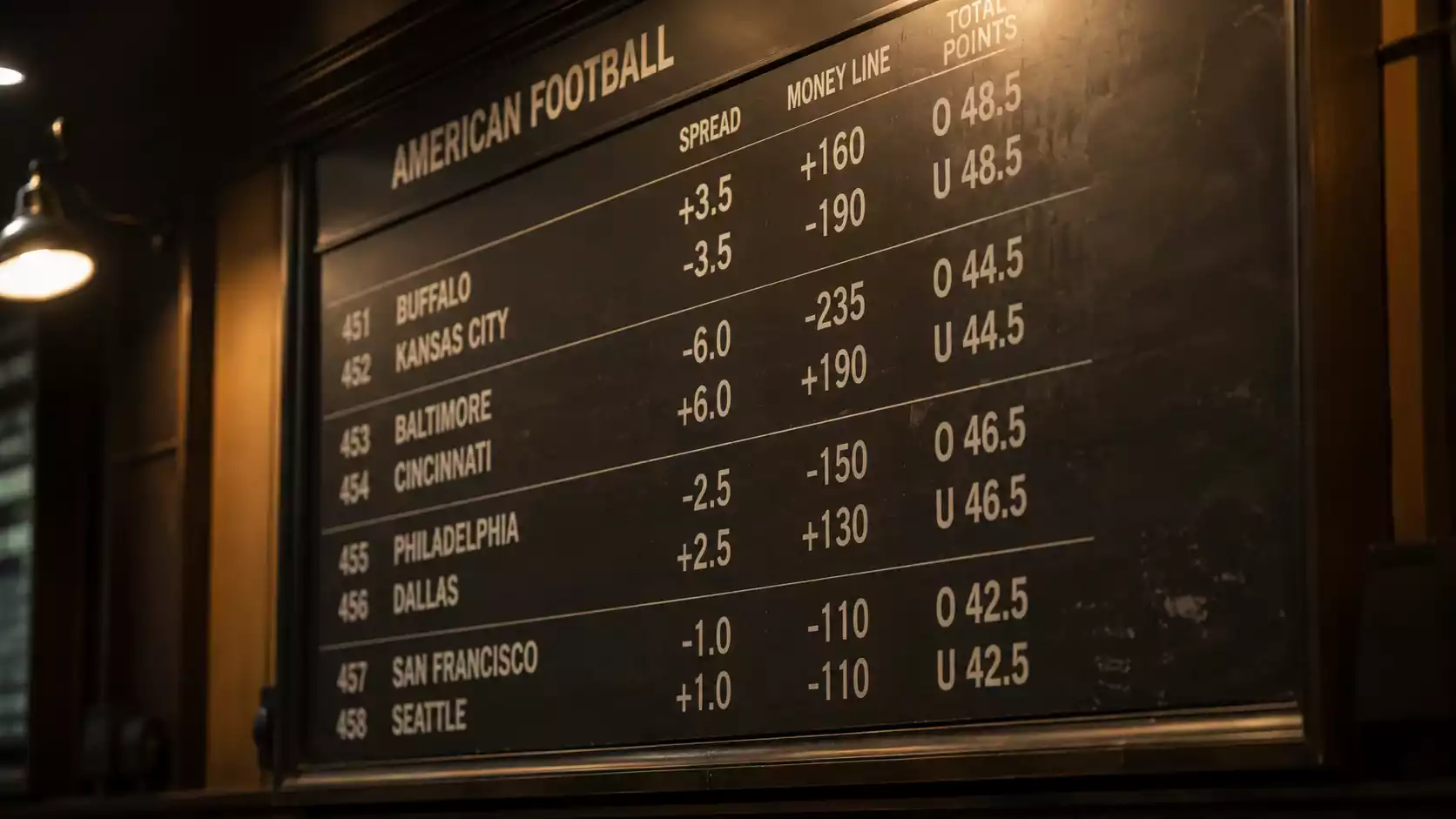
A few seasons back, a bookmaker trader told me something that changed how I think about futures pricing. He said his team didn’t set Super Bowl odds based on what they thought the true probabilities were. They set odds based on the risk they were willing to carry on each outcome — and those two things are often not the same. A team they privately rated at 12% to win the championship might be priced at 8% (12/1) because they’d already taken heavy money on it and needed to discourage further action, or at 16% (5/1) because they needed to attract balancing money on the other side. Understanding that bookmakers are managing liability, not expressing beliefs, is the single most important insight for a futures bettor.
NFL futures represent a massive liability management challenge for bookmakers. With over $30 billion wagered on the NFL through legal US sportsbooks alone in the 2025 season — and the UK market adding significant additional volume — the total money at risk on outright futures is enormous. A popular team winning the Super Bowl after attracting heavy public money can cost a single operator tens of millions. That risk shapes every price on the board.
Bookmaker Futures Pricing Adjustments
The initial odds-setting process for NFL futures begins shortly after the Super Bowl, when the bookmaker’s trading team projects probabilities for the coming season. These opening lines are the closest thing you’ll find to the bookmaker’s genuine assessment of each team’s chances, because at that point no public money has been taken and there’s no liability to manage. Opening lines are set based on roster evaluation, coaching analysis, schedule projection, and increasingly on quantitative models that incorporate metrics like EPA and DVOA.
The moment those odds are posted, the picture changes. Public money begins flowing, and it flows unevenly. Popular teams — historically successful franchises with large fanbases, teams that made deep playoff runs the previous year, and teams with exciting young quarterbacks — attract disproportionate betting volume. Within days or weeks of opening, the bookmaker has built up a liability position: too much money on some teams and not enough on others.
The response is price adjustment. The bookmaker shortens odds on the over-bet teams (making them less attractive to new bettors) and lengthens odds on the under-bet teams (making them more attractive). This rebalancing happens continuously throughout the offseason and into the season itself. The key insight is that post-opening odds reflect a blend of probability assessment and liability management — and the further from opening, the more the liability component dominates.
This means the most analytically clean odds are available immediately after opening, before public money distorts the prices. I set calendar reminders for the major UK bookmakers’ opening windows and place my initial positions within the first 48-72 hours. These early prices aren’t always the best — sometimes a team’s odds lengthen later for informational reasons — but they’re the most undistorted by liability effects.
Reading Liability Data: What It Tells You About Line Value
Most UK bookmakers don’t publish their liability positions, but enough information leaks through industry commentary to be useful. US-based sportsbooks are more transparent — BetMGM, for instance, regularly reveals which teams represent their worst-case outcomes. When their trading manager Christian Cipollini names specific teams as the organisation’s “worst outcomes” among legitimate contenders, he’s telling you that those teams have attracted enough public money to create meaningful liability. That’s invaluable intelligence.
Liability-heavy teams are teams whose odds have been shortened beyond what the bookmaker’s probability model would justify, purely to manage risk. For a bettor, this means the current price on that team is less generous than it should be — the bookmaker is essentially taxing your bet to offset the risk created by other bettors’ money. Conversely, the teams on the other side of the liability ledger — the ones the bookmaker would love to see win because they’d pay out very little — are priced more generously than the underlying probabilities warrant.
I maintain a mental model of which teams are likely to be public favourites each season. Teams that won their conference the previous year, teams with nationally prominent quarterbacks, and teams based in large media markets attract the most public money. At the start of each season, I assume these teams’ odds are compressed by liability management and look for value on the teams sitting opposite them in the ledger — the mid-market contenders with strong fundamentals but lower public profiles.
Ticket Count vs Handle: Spotting the Smart Money
The distinction between ticket count and handle (total money wagered) is one of the most useful analytical tools for reading futures market dynamics, even when you don’t have access to the specific numbers.
Ticket count tells you how many individual bets have been placed on a selection. Handle tells you how much total money those bets represent. When a team attracts a high ticket count but low handle, it’s being bet primarily by casual bettors placing small stakes — the “public” side of the market. When a team attracts a low ticket count but high handle, it’s being bet by fewer bettors placing larger stakes — typically more sophisticated bettors whose positions are larger because their conviction is backed by analytical work.
The most interesting scenario is a divergence: a team that’s receiving, say, 15% of all tickets but 25% of the total handle. That gap tells you that someone — or a small number of someones — is placing significant money on that team. The bookmaker notices this divergence immediately and may adjust the odds to reflect the larger positions, even if the total number of bets is modest. For an outside observer, this divergence is a signal worth investigating: why are larger bettors concentrating on this selection?
UK bettors can’t access ticket and handle data directly from their bookmakers, but monitoring odds movements for signs of this divergence is possible. A team whose odds shorten noticeably during a quiet news period — no signings, no injuries, no draft picks — is often being moved by large-stake positions rather than casual public interest. Tracking these unexplained movements and cross-referencing them with your own analysis can surface opportunities where sophisticated money has identified a value gap that the broader market hasn’t yet closed. The line movement guide covers the techniques for monitoring and interpreting these kinds of odds shifts.
Can UK bettors access sportsbook liability data for NFL futures?
UK bookmakers do not publish their liability positions. However, US sportsbooks — particularly BetMGM — regularly share information about which teams represent their worst-case outcomes through industry media and press releases. Monitoring these disclosures gives UK bettors useful insight into where public money has concentrated and which teams’ odds have been adjusted for liability reasons rather than analytical ones.
Does a team attracting the most public money always have shorter odds?
Generally yes, but not always. Bookmakers shorten odds on heavily bet teams to manage liability, which means public favourites tend to carry compressed prices. However, if the bookmaker also receives significant large-stake positions on the opposite side, the odds may not shorten as much as the public ticket count alone would suggest. The balance between public money and sharp money determines the final price — and that balance is where the most useful analytical information lies.
Written by the editors at Best nfl Futures Bets.